|
Tristan da Cunha:
The Most Isolated Inhabited Island in the World
Tristan da Cunha, rising to over 2000m above sea level, is miles from anywhere in the South Atlantic Ocean. With its neighbouring islands of Nightingale and Inaccessible, and Gough Island, 300km to the SE, it warrants a mention in the Guinness Book of Records as the most isolated inhabited island in the world, being over 1,900km from St Helena and 2,400 west of Cape Town.
Only the island of Tristan da Cunha itself is inhabited. At the start of the millennium, the population (which has never exceeded 300 throughout the previous 184 years of occupation) totalled 284.
Being isolated and devoid of all living organisms at its volcanic origin, the evolving flora and fauna of the island hold a special interest for scientists and visitors. The Tristan Government is keenly aware of the need to live in balance with its environment because the economy of the community is dependent on sustainable harvests of lobster and fish. The Department of Natural Resources is responsible for administering the Island’s strict environmental policies. Over 40% of Tristan’s territory is a declared nature reserve and Gough Island is a World Heritage Site.
There are no indigenous terrestrial mammals. Man has left his mark on the main island and the introduction of rats and mice in the 1880s destroyed much of Tristan Island’s indigenous bird life. Fortunately the islands of Nightingale and Inaccessible remain rodent free and are home to several unique indigenous land birds. Continual education of new generations of Tristanians is required to safeguard their special environment.
The Tristan da Cunha Government, through its Natural Resources Department, created in 2009, works in partnership with UK conservation organisations on a range of issues relating to its biodiversity. Individual projects have been funded by the UK Government's Darwin Initiative and Overseas Territories Environment Programme. Tristan has also benefited from ongoing support from staff at the University of Cape Town who are involved with on-going research into Tristan da Cunha Islands' unique wildlife.
|
 |
 |
|
|
| click images for larger versions |
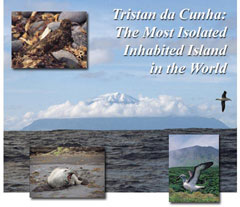
Those islands still rodent-free support unique indigenous land-birds, including the Tristan thrush (pictured) and the rare Inaccessible rail, the smallest flightless bird in the world.
Millions of seabirds, such as yellow-nosed albatross (pictured) and greater shearwater, breed - as do fur seals and elephant seals (pictured), now recovering from the hunting of the 19th century. |
| Photographs courtesy of Brian Baldwin |
|
|
|
|
|
|