|
The Bailiwick of Guernsey
Broad Diversity in a Small Compass
The Bailiwick of Guernsey includes the island of Guernsey and the neighbouring islands of Alderney, Sark, Brecqhou, Herm, Jethou and Lihou. It has a total land area of 78 km2 with a population of 62,000. For some aspects, Alderney and Sark are self-governing.
Along with the separate Bailiwick of Jersey, it constitutes the archipelago of the Channel Islands, located in the English Channel. They formed part of the Dukedom of Normandy when, in 1066, that Dukedom invaded and conquered England, making it in effect a Norman overseas territory. They remain linked to the Crown as independent territories, and have a special relationship with the European Community. Their biogeographical area includes the adjacent French mainland, as well as the southern coast of England.
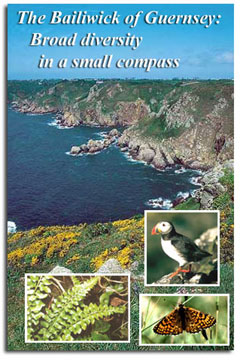
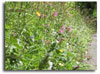
The islands' 10-metre tides provide a large littoral zone, supporting a wide range of marine species and many species of waders (shorebirds). Migrating land-birds such as wheatears and pipits rest in the dune grassland, whilst inland fragments of threatened wet meadow habitat are managed for their summer display of orchids and other rare plants. In the fragmented woodland, warblers, long-eared owl and short-toed treecreeper breed.
 On the cliff-land, the maritime grassland supports the rare Glanville fritillary butterfly (inset) and cliff-top scrub hosts resident Dartford warbler, stonechat and many species of migrant bird, which use Guernsey as a vital refuelling stop in spring and autumn. On the cliff-land, the maritime grassland supports the rare Glanville fritillary butterfly (inset) and cliff-top scrub hosts resident Dartford warbler, stonechat and many species of migrant bird, which use Guernsey as a vital refuelling stop in spring and autumn.
In an attempt to improve the Island's biodiversity further, local authorities have implemented a new system of farm subsidy. This programme aims to make farming less intensive and encourages farmers to undertake various conservation measures.
Alderney, the most northerly of the Channel Islands has a total area of 8 km² and a population of 2400 people. The Alderney Wildlife Trust helps to maintain two nature reserves and the island's Wetland of International Importance under the Ramsar Convention officially known as 'Alderney West Coast and Burhou Islands' which was designated in 2005.
Sark is the smallest of the Channel Islands covering 5.44km², Société Sercquiaise is affiliated to La Société Guernesiaise which exists to encourage the study of the history, natural history, geography and geology of the Bailiwick of Guernsey, the conservation of the Bailiwick’s natural environment and the preservation of its historic buildings and monuments.
|
|

|