|
Ascension Island: - more than meets the eye
Ascension Island lies in splendid isolation, just south of the equator, in the middle of the Atlantic. It has spectacular volcanic scenery. Because of its remoteness, it was not settled until the 19th century when Napoleon was held captive on the neighbouring island of St Helena, 1,300 km away. At that time, the main island, though very barren, held huge populations of seabirds. However, rats soon arrived by ship, and donkeys and cats were deliberately introduced.
In an effort to beautify the island, many tropical flowers were planted. The result of all these introductions was the rapid decline in seabird numbers so that, until the early 2000s, most could nest only on smaller islets off-shore. The successful project to remove feral cats is allowing some re-colonisation of the main island.
The local voluntary conservation organisation is the Ascension Heritage Society.
Over recent years, earlier problems have been overcome, partly by a successful programme, coordinated by The Ascension Conservation Centre (of the Island Government), to educate the public of the value of Ascension's biodiversity and involve them in its conservation. This has assisted in successful projects to address the spread of introduced species, particularly mesquite thorn, cats and rats.
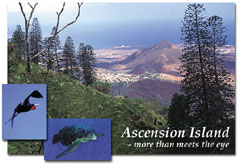
Feral cats were successfully removed by 2006 and all pet cats are neutered. This has allowed seabirds, including two globally endangered birds, the endemic Ascension Frigatebird (pictured) and the Red-footed Booby, to start re-colonising from the tiny refuge of Boatswain-bird Island to the main island of Ascension. The relatively recently introduced Mexican Thorn bush impacts some of the surviving unique desert flora and fauna and some geological features, but is managed to keep it off the beaches vital for nesting by Ascension’s Green Turtle
(pictured) population, the largest in the Atlantic.
about Virtual Tours...

|
 |
 |
|
|
| click image for larger photos |
| Much of Ascension's global conservation importance comes from the island's remoteness, which has produced one of the most remarkable island floras and faunas in the world. It is of world significance for its 11 species of breeding seabird, especially the unique Ascension Island Frigate Bird. It has also one of the most important breeding Green Turtle populations in the world. There are 7 unique species of land plants, at least 13 of marine fish and shellfish, and over 20 of land invertebrates. |
| Photograph of Frigatebird - J. Stevenson (RSPB) |
|
|
|
|